

Delicious Ghosts: Two Perfect Winter Pestos
January Blues Be Gone

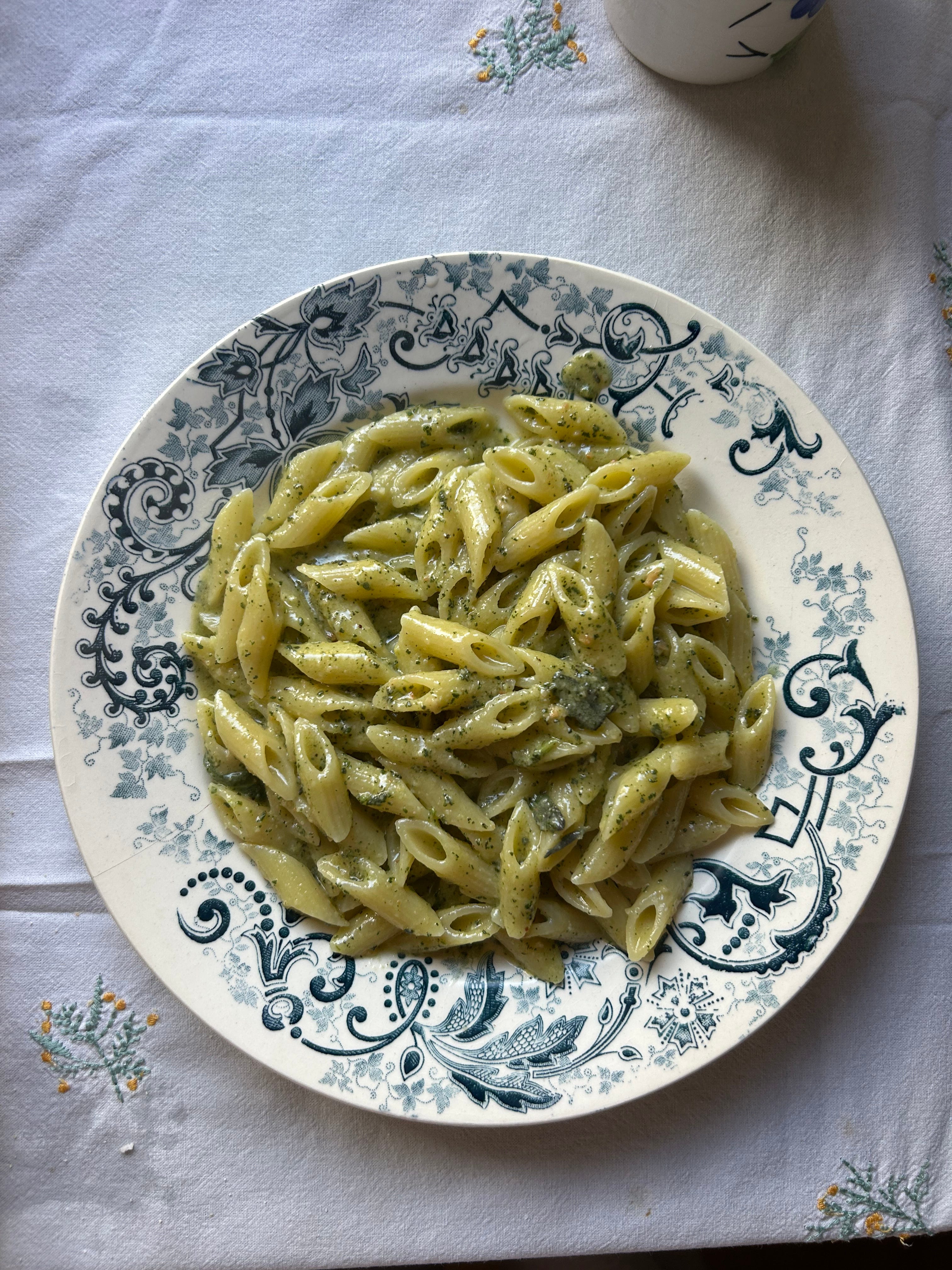
Sage & Hazelnut Pesto
Some recipes will not leave you alone. They haunt you like delicious ghosts. This pesto first flickered onto my horizon last September when I was cooking at Anna Tasca Lanza. I heard that Fabrizia Lanza, one of the best cooks and sagest women I have ever met, made a version. Of course, I forgot all about it. Then, it popped into my inbox again over Christmas in a recipe by Bee Wilson. Seeing as both Fabrizia and Bee have perfect palates (Fabrizia eats anchovies on toast for breakfast), it seemed I could no longer avoid it.
Sage, or Salvia as it is known in Italian, is one of my favourite herbs, and an ingredient the Italians use prolifically. The English kitchen seems to save it mostly for stuffing, perhaps at a push paired with pumpkin. This is a shame, because it lends itself to so much more. I wrote in Bitter Honey how pasta with parmesan and sage butter is my ultimate comfort dish. The Italian word for sage derives (thank you Wikipedia) from the Latin meaning salve, to save, heal or healthy, and the Romans believed the herb was good for all that ails you, mentally or physically. In fact, there was a Latin saying that went, ‘what man need die when he has sage in the garden?’. Now, they meant this medicinally (as in sage could literally cure all sorts of things from flatulence to sort throats) but I like to think of it metaphorically too. No need to give in to January depression when you can inhale a hit of fresh sage melting into your plate of pasta.
If you needed further proof, The Oxford Companion to Italian Food, always a favourite to flick through, says that ‘sage has traditionally been used to assuage the ravages, both mental and physical, of fevers and nervous afflictions’. So, what sage-rich dish could be more fitting for the deepest, darkest dreariness of winter?
In reality, sage is a year-round herb, at least in Italy. My little Salvia bush is as perky in summer as it is in winter. In summer we fry the leaves in batter, and mix them into butter for ravioli, in winter I want to make this. Fabrizia’s version, which uses almonds (harvested in the summer) is listed in her summer recipes, and it would work equally well. She serves it with a ricotta and mint stuffed ravioli, which would be a winning combination; sage and mint come from the same family and complement each other perfectly. I can also highly recommend fresh sage and mint tea. In fact I’m going to make a pot now.
An aside: Some years ago, I lodged in Clapton with a semi-famous actress who once accused me of being an alcoholic. She said it was the only explanation she could find for my chaotic lifestyle and anti-social hours. I tried to explain I was a chef. It was a short-lived and mostly unhappy union, but she did introduce me to this combination, which I have never forgotten. She used to put some sprigs of fresh sage and mint into a nice Japanese ceramic tea pot and pour boiling water over them. It made the kitchen smell like some sort of Swiss mountain spa, and it tasted like tonic.
The Possibilities of Pesto
I feel the need to urge you that pesto need not just be for pasta! There are so many other good things to do with it. Stir it into soups (anything beany or root vegetable based would work in this case), use it to crown bruschetta (whipped ricotta, melted mozzarella, or wilted greens underneath, or the cheese and the greens!). Pour it over braised beans on toast, or drizzle it over roasted or sauteed or even boiled vegetables (purple sprouting or tenderstem broccoli, roasted pumpkin, beetroot, parsnip, celeriac, you get my drift).
There is something witchy about herbs, about dreaming of drying sprigs of them in my imaginary larder, and then pounding them into some sort of potion (Bee advises making this in a pestle and mortar, which would be wonderful and witchy. My blender felt much more banal). Perhaps this is, in part, due to their medicinal associations.
To cure all ills, and dispel the January blues. It tastes less strong and sagey than you’d think.
For the Love of a Lemon
I nearly always add lemon to my pestos, a little zest and juice helps to cut the richness perfectly. As sage, like it’s sister mint, has citrus undertones I did the same here, and urge you to consider it.
A Moveable Feast
Pesto is a moveable feast. It is infinitely adaptable. This is the part of the fun of it. You can easily switch out the herbs, the nuts, the cheeses. Ricotta salata would be a good substitute for parmesan (just watch the salt levels), as would a mature pecorino. Some creamy fresh ricotta in combination with parmesan for depth would also be good. Walnuts would work beautifully. As would pine nuts. Fabrizia use’s almonds. And so on and so forth…
Cupping
I never measure anything for my pestos. Ever. But then I had to write books with pesto recipes in them and obviously I had to measure these recipes. It bothers me to measure a pesto, because it sort of goes against the principle of pesto, which – like a soup or salad, is very much a throw-things-together affair. However, it helps if you are not a confident cook to have some kind of guidelines for the quantities of nuts/cheese/herbs which are so fundamental in making up the perfect balance of a perfect pesto. And now I have discovered cups. It has taken me about 20 years to get into cup measures, a fact I am embarrassed to admit. As my collection of American cookbooks grew, it seemed crazy not to bite the bullet. So many of my favourite recipes or things I want to try making (so many pastas and chicken dishes and bakes specifically) are in the New York Times or a book by an American cook. It was time. I gifted myself some cup measures this Christmas. And then I discovered they are the perfect thing for pesto.
And so, I give this recipe in cups, exactly as I made it. (if you don’t have cup measures, I’’ translate it roughly to grams, but I highly recommend the cups!)
Makes 3 servings
1 cup of washed and picked fresh sage leaves
Half a cup of best olive oil
Scant half a cup of nuts (I used hazelnuts)
A third of a cup of grated cheese (I used parmesan)
Zest and juice of half a large lemon (more or less to taste)
1 clove of garlic, peeled
A good pinch of salt (season to taste!)
A little black pepper
Blitz everything and serve on al dente pasta, following the pasta and water method as in the previous recipe.
Fresh Ricotta and Rocket Pesto
This is something I have made in various ways for years, but this was my most successful version to date. I made it to use up two bunches of rocket I had bought before Christmas which were wilting away in the vegetable drawer and it was so good I served it to guests. As you will all know by now, I do not hold with distinctions between home food and ‘dinner party’ food. Sure, there are some truly hideous fridge-forage suppers that I’d be reluctant to remake for friends, but you catch my drift. All I really want to eat in anyone’s home is a good example of their own home cooking, and I apply this rule rigorously to my own entertaining.
It was so good everyone had seconds, even though we had an ungodly amount of cheese and salami to start, as well as a massive bruschetta with seasoned sheep’s ricotta too. As with all pestos, you can make this a totally pistachio-green smooth situation, or do it by hand (or pulse in the machine) and leave it loose and rustic. I like it either way, though the creamiest result is obviously the smooth one. To emphasise this creaminess I used a small pasta shape, so the finished assembly pools onto the plate like good risotto.
Serves 4-6
2 bunches of rocket (or 2 small bags/1 large bag full)
80g of almonds, skin on is fine
A good pinch of salt
150g good ricotta (if you can find sheep’s milk, amazing, if not tub is fine)
80g or so of grated parmesan
Juice and zest of 1 lemon
1 clove of garlic, peeled
About 60ml best olive oil
Blitz or pulse everything in the blender until you have the desired result (whether smooth or chunky). Taste for seasoning adjusting accordingly (you may well need more lemon or salt or parmesan.
Boil 100g of pasta per person in a large pan of salty water. Reserve some cooking water, drain the pasta, then stir in the pesto and some of the reserved water. Cook over a low heat for a few minutes, adjusting the seasoning and stirring until very creamy and saucy but not swimming.
Serve, with an extra drizzle of your best olive oil, if you like.